
F-TEM

Flexible Thermoelectric Module
[Standard part AR-TEM es-02]
Solid-state semiconductor devices, thermoelectric modules have the two primary functions of thermal gradient electric generator and heat pump utilizing the Seebeck and Peltier effects, respectively.
Typically a rigid device where the semiconductor elements are sandwiched between ceramic plates, Asahi Rubber has innovated a method of incorporating those same elements in a rubber substrate for a new set of target uses.
Applications
Thermoelectric devices are ideal for uses which can take advantage of:
・Solid state, no fluids, low maintenance
・Rapid on/off switching, fine temperature control
・Small form factor
・Easy setup
・Silent
Rubber Substrate
Within thermoelectric devices, F-TEM is particularly suited for uses which benefit from these advantages:

Conforms to:
・Curved surfaces
・Rough surfaces without interface filler

Crack Resistant
Avoids early failure mode of thermoelectric devices of condensation ingress in cracks

Shock Resistant
The cushioning rubber substrate protects internal elements from sudden impact effects

Vibration Resistant
Rubber naturally dampens vibration for greater resiliency in such environments

Lightweight
Compared to similar ceramic options
*
F-TEM is not intended for rugged applications with significant repeated bending or physical stress, especially tensile stress, which can break the internal circuitry. The device is flexible and is intended to accept bending to conform to a curved or somewhat uneven surface and be fixed in that position, or where repeated bending occurs it is limited and controlled.
Peltier Effect
By applying an electric current a thermoelectric device will create a thermal gradient: it becomes a solid-state heat pump
Reversing electric polarity in turn reverses the heat pump direction

Seebeck Effect

The reverse of the Peltier effect, thermoelectric devices can use the Seebeck effect to generate electricity from a temperature gradient
Harvest waste heat for low-power applications such as remote sensors
Customization
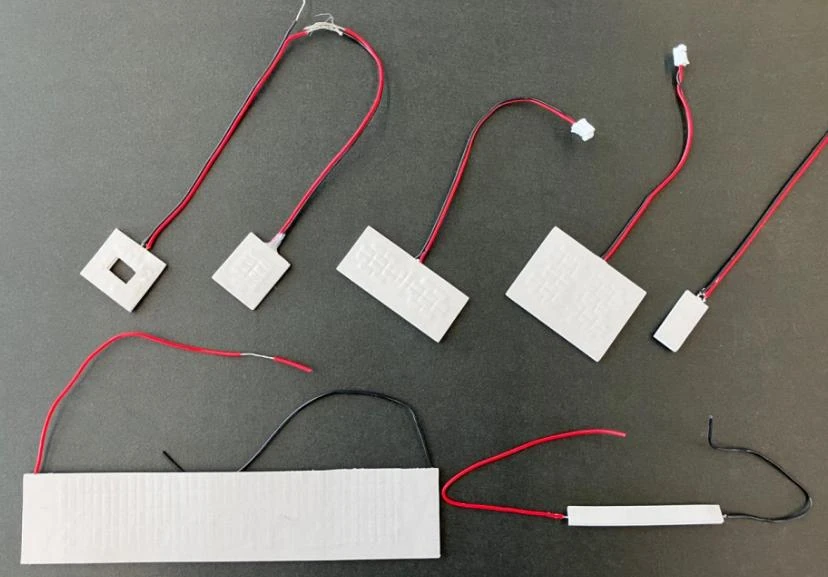
Asahi Rubber has begun supporting custom form factors of our F-TEM product, and we are continually improving our capabilities.
FAQ
Is there a design fee?
Consideration is made on a case-by-case basis. Because designing a custom form-factor circuit can be resource-intensive, we have to ensure inquiries are serious as well as avoiding excessive iterative requests.
What is the available peak heat transfer performance (Qcmax) for my intended form factor?
Analyzing our standard AR-TEM es-02 to approximate, the active area is 37.8×32.2 or 1217.16mm2 with a Qcmax of 19.5W, so consider a Qcmax/mm2 of 0.016W as a rule of thumb and calculate based on the active area of your own design.
Maximum possible Qcmax may be lower with an irregular shape when circuit layout is constrained; alternatively in some cases increased element density may be possible for a higher Qcmax.
What is the minimum bending radius?
Minimum bending radius is r=25mm.
In some designs a smaller radius may be possible where this tighter bending area is limited to inactive surface.
What other design constraints should be considered?
- Bending causes stress on the internal circuit of F-TEM, and excessive bending in depth or repetition can cause internal circuit failure. F-TEM is intended for usage at a given fixed bend position.
- The minimal inactive area margin is arbitrary, but there must be enough material to seal and protect the internal elements from moisture ingress as condensation is a primary fail mode of thermoelectric devices. Best practice is at least 3.5mm of inactive material cushion.
- Our manufacturing processes limit designs to those produced flat and bent after manufacture.
Can thickness be customized?
At this time we are unable to support custom thicknesses. t=2.15mm is available, equivalent to our standard AR-TEM es-02.